
What if some of the most meaningful returns on investment are the ones we're not measuring?
For associations, return on investment (ROI) is often defined by familiar metrics: revenue generated, membership growth, retention rates, event registrations, and operational cost savings.
These are important indicators of organizational health. They help justify investments, inform strategic decisions, and demonstrate accountability to boards and stakeholders.
But they don't always capture the full picture.
What about the member who finds an answer in seconds instead of spending half an hour searching? The staff member who can focus on a more meaningful project instead of answering the same question repeatedly? Or the conference attendee who can navigate an unfamiliar event in their preferred language?
There's value in each of these experiences, even when that value doesn't immediately translate into dollars.
Perhaps it's time to expand how we think about ROI.
ROI Isn't Always Financial
When evaluating a new initiative, technology, or member service, associations naturally want to understand whether the investment is worthwhile.
The challenge is that traditional ROI calculations tend to prioritize outcomes that are easy to quantify.
Revenue is measurable. Expenses are measurable. Membership growth is measurable.
But some of the most meaningful benefits associations provide are less straightforward.
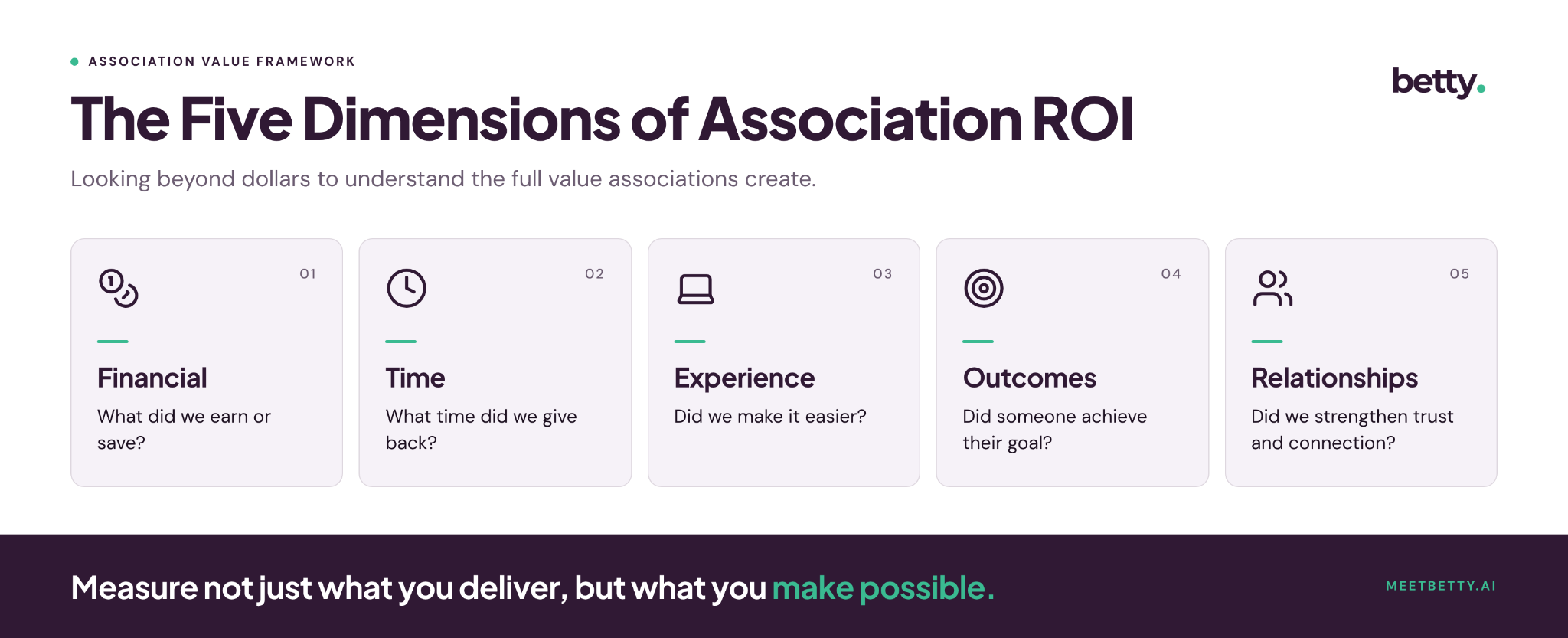
Consider five dimensions of association ROI:
- Financial ROI: Revenue generated, costs reduced, and resources used more effectively.
- Time ROI: Time returned to members and staff through faster answers, simpler processes, and less repetitive work.
- Experience ROI: Reduced frustration, greater satisfaction, and easier access to information and services.
- Outcome ROI: Members successfully completing tasks, solving problems, and making informed decisions.
- Relationship ROI: Stronger trust, greater confidence in the association, and a deeper understanding of membership value.
These dimensions aren't mutually exclusive. A single improvement might save time, increase satisfaction, and strengthen a member's relationship with the association.
And importantly, these outcomes aren't necessarily intangible. Many can be measured. They simply require us to ask different questions.
Are We Measuring Activity or Impact?
Associations have access to more data than ever before.
We can track website visits, content downloads, email engagement, event attendance, and increasingly, interactions with AI-powered tools.
But activity doesn't always equal impact.
A resource receiving 1,000 downloads tells us people are interested. It doesn't tell us whether they found the information useful.
A website attracting thousands of visitors demonstrates reach. It doesn't necessarily mean those visitors accomplished what they came to do.
Even an AI assistant answering hundreds of questions doesn't automatically tell us whether those answers helped someone solve a problem.
These metrics are valuable starting points, but they aren't the whole story.
What if we asked different questions?
Instead of simply measuring how many people accessed a resource, we could ask whether they found what they needed.
Instead of focusing exclusively on engagement, we could examine whether that engagement led to a meaningful outcome.
And instead of evaluating efficiency only through cost savings, we could consider how time saved creates opportunities for more valuable work.
The shift is subtle but important: from measuring what we deliver to understanding what people accomplish because of it.
The Member Has an ROI, Too
When associations discuss ROI, the conversation typically centers on the organization's investment.
Did the new initiative generate revenue? Did it reduce expenses? Was the technology worth the cost?
But members are making investments of their own.
They invest membership dues, professional development budgets, time, attention, and trust.
And they're looking for a return.
Sometimes that return is tangible: earning a certification, discovering a new opportunity, or accessing a resource that helps them do their job.
Other times, it's less obvious.
It's the convenience of finding reliable information without waiting for office hours. The relief of navigating a complicated process without confusion. Or the confidence of knowing where to turn when a question arises.
These moments shape how members experience the value of their association.
And while they may not appear as individual line items in a financial report, they can influence satisfaction, engagement, loyalty, and the perceived value of membership.
That raises an important question:
Are we measuring only the return on our association's investment, or are we also considering the return on our members' investment in us?
AI Is Helping Associations Recognize More Dimensions of ROI
Artificial intelligence is bringing this conversation into sharper focus.
Across the association community, organizations are exploring how AI can improve access to knowledge, simplify member experiences, and reduce repetitive administrative work.
The most interesting opportunities, however, aren't necessarily about the technology itself.
They're about what the technology makes possible.
And increasingly, associations are finding ways to measure those benefits.
Society of Women Engineers: The Value of Time and Accessibility
For the Society of Women Engineers (SWE), supporting thousands of conference attendees presents a significant logistical challenge.
Its annual WE Conference brings together more than 14,000 attendees from 40 countries, including many first-time participants navigating hundreds of sessions, exhibitors, and networking opportunities.
Attendees need answers about everything from conference logistics and session schedules to career fair preparation. Traditionally, those questions required navigating multiple resources or contacting association staff.
SWE introduced Enginuity, an AI-powered conference assistant, to make information easier to access while reducing repetitive support requests.
The reported results illustrate several dimensions of ROI:
- 63.4 staff hours saved through automated responses to routine questions.
- 19% fewer conference support cases, with cases declining from 933 at WE24 to 752 at WE25.
- Support in more than 50 languages, making conference information more accessible to international attendees.
- 997 conversations across 806 unique users, demonstrating engagement with the resource.
The staff time savings and reduction in support cases represent measurable operational returns.
But the story doesn't end there.
Consider the value of an international attendee being able to ask a question in their preferred language. Or a first-time participant getting immediate guidance without waiting for a response from conference staff.
These experiences represent potential returns in accessibility, convenience, and confidence that traditional financial reporting might overlook.
SWE's experience demonstrates how an investment designed to improve support can also create opportunities to enhance the attendee experience.
National Science Teaching Association: The Value of Getting Answers When You Need Them
The National Science Teaching Association (NSTA) faced a different but equally familiar challenge: providing timely support to members without continually expanding staff capacity.
Members frequently needed assistance with account questions, educational resources, lesson plans, conference information, and science-related topics.
NSTA introduced Atom, an AI-powered knowledge assistant that provides answers around the clock.
Within its first few months, Atom demonstrated several reported results:
- 35% reduction in support tickets during the initial three-month reporting period.
- More than 2,000 questions answered across membership support, educational resources, and other topics.
- Response times under five seconds, giving users immediate access to information.
- Four memberships sold through interactions with Atom.
These results offer an interesting perspective on ROI.
The memberships sold represent a direct financial return. The reduction in support tickets suggests operational benefits. And the ability to receive answers in seconds, regardless of business hours, creates opportunities to improve the member experience.
But perhaps the most important question is what happens after someone receives an answer.
Were they able to resolve their issue? Find a useful teaching resource? Complete a membership-related task? Get back to their work without unnecessary delays?
Those outcomes are worth understanding, even when they don't generate an immediate transaction.
NSTA's experience shows how financial, operational, and experiential returns can coexist within a single initiative.
Making the Less Obvious Measurable
These examples demonstrate that associations don't have to choose between financial accountability and a broader definition of value.
They can measure both.
The opportunity is to connect traditional performance indicators with the experiences and outcomes those numbers represent.
Associations can begin by identifying what they want to improve and asking how they'll know whether the improvement is making a difference.
If the goal is saving time: Measure how long it takes someone to complete a task before and after an improvement. Consider both staff time and member time.
If the goal is improving member experience: Gather feedback on ease of use, satisfaction, and whether members found what they needed.
If the goal is increasing accessibility: Examine when and how members access resources, what barriers have been reduced, and whether more people can successfully use the service.
If the goal is improving effectiveness: Look at task completion, successful resolutions, and the next steps members are able to take.
If the goal is supporting staff: Evaluate whether repetitive work is decreasing and what teams are able to accomplish with the capacity they gain.
If the goal is strengthening relationships: Explore whether members increasingly recognize, trust, and rely on the association as a valuable professional resource.
Not every outcome needs a perfect dollar value attached to it.
And not every improvement can be attributed to a single initiative.
The goal is to establish meaningful indicators that help organizations understand whether they're creating the experiences and outcomes that matter.
Sometimes this can start with something as simple as asking members:
"Were you able to accomplish what you came here to do?"
That single question can reveal something that dozens of traditional engagement metrics might miss.
A More Complete Definition of Success
Financial performance will always be an important part of association ROI. Organizations need sustainable business models to fulfill their missions and serve their communities.
But financial returns are only one part of the value equation.
Time matters. Satisfaction matters. Accessibility matters. Confidence matters.
And perhaps most importantly, helping someone accomplish what they came to do matters.
As associations continue investing in new technologies, services, and experiences, there's an opportunity to rethink what success looks like and how we demonstrate it.
The next time we evaluate an initiative, we might ask more than whether it generated revenue, reduced costs, or increased engagement.
We might also ask:
Did we make something easier? Did we give someone time back? Did we help someone make a better decision or accomplish something meaningful?
Because sometimes the greatest return on investment isn't what an organization gains.
It's what the people it serves are able to do.
What forms of ROI is your association creating that might not be reflected in your traditional success metrics? And what could you learn by starting to measure them?