It usually comes up at a board meeting. Someone leans in and asks, "So what are our members actually struggling with right now?"
And the honest answer, at most associations, is an educated guess. It's built from last year's member survey, a handful of memorable emails, and whatever the front desk heard most this week. Not because anyone is careless, but because nobody's job is to know.
Here's the thing: the answer already exists. Your members are telling you every day, in support tickets, search bars, event Q&A, renewal calls and chat logs. You're collecting more member data than ever. You just never staffed the department that's supposed to listen to it.
The department nobody hired for
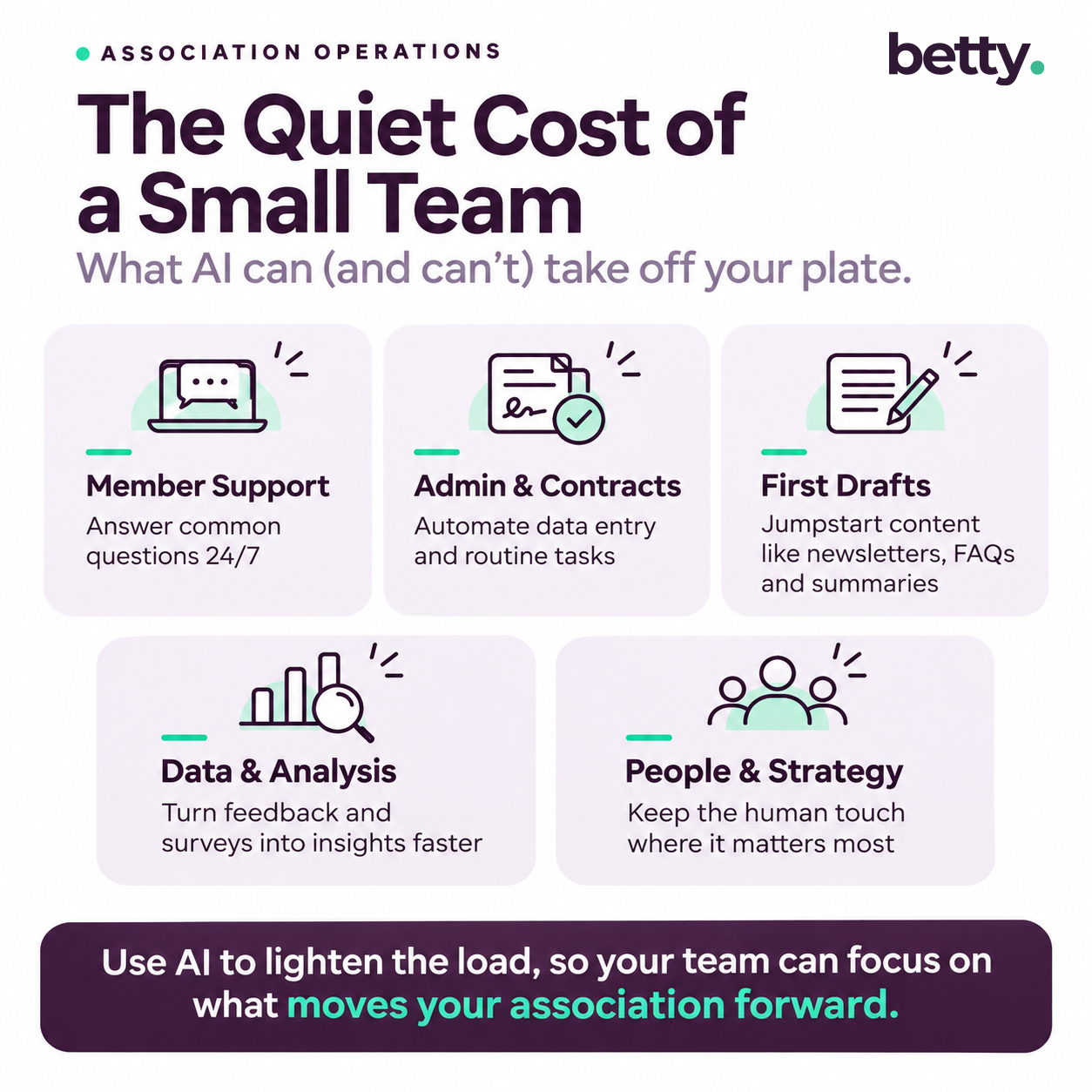
The staffing picture is improving. Naylor's 2026 Association Benchmarking Report found reported understaffing fell from 51.3% to 35.1% over the past year. But one area hasn't caught up: data and strategy remains the most understaffed area, at 38.5%. (My colleague Johanna dug into what that means for small teams in The quiet cost of a small team.)
That tracks with what we see. Data work has no deadline. Renewals have a deadline. The annual meeting has a deadline. The inbox always has a deadline. So the work of reading what members are telling you gets pushed to "next quarter," and next quarter never comes.
Nobody sends an alert when that work doesn't happen. You just keep making decisions on instinct.
This isn't really a headcount problem. Most associations don't need a data team. They need someone, or something, closing the gap between collecting member data and acting on it.
Your members are already telling you what they need
Every question a member asks is a data point. "Does this webinar count toward my credits?" tells you something about how clear your CE policy is. Twenty versions of the same question tell you a lot more.
And every search that comes back empty is a request. It's a member saying, in their own words, "I expected you to have this." Most associations never see those requests. They disappear the moment the member closes the tab.
When members ask an AI assistant instead of digging through menus, those questions stop disappearing. You can see what people asked, how they phrased it, and where your content came up short. That's not a nice-to-have report. It's the closest thing you have to a live member needs assessment, running every day of the year.
We're watching this happen right now. One technical association we work with noticed a cluster of questions in its assistant's logs: members asking how to work through a specific set of calculations. The questions pointed to a gap in its published content. So instead of answering them one at a time, the association's technical team knows they need to write a dedicated article on exactly those calculations, shaped by what members actually asked.
That's become part of how they plan content. When a gap shows up in the questions, they write into it.
Dashboards aren't the same as listening
Most associations do have data. They have page views, downloads, open rates and attendance counts, neatly arranged on a dashboard someone checks once a month.
But those numbers measure activity, not need. Your most-viewed page tells you what you promoted. Your most-asked question tells you what members actually need. Those are rarely the same list.
A download count can't tell you whether the member found what they were looking for. A question can. It comes with context, urgency and the member's own language, which is exactly what you need to write better content, fix a confusing process, or make the case to your board.
You don't have a data problem. You have a nobody-reads-it problem.
What it looks like when this department is staffed
Staffing your data doesn't mean hiring an analyst. It means pairing a tool that captures and sorts what members are asking with a person who owns what happens next. The best insights in the world still need someone to drive action in order to deliver impact for your members.
When that pairing works, it looks like this:
- Content gaps get filled before members get frustrated. You see the questions your resources can't answer, and you write the answers.
- Confusing policies surface on their own. When the same question about one policy keeps coming up, that's a signal to rewrite the policy, not just answer it again.
- Event programming starts from real demand. Last year's questions become this year's session topics.
- Board reports carry member voices. Instead of "we think members want," you can show what members asked, how often, and in their own words.
The guardrail matters here too. AI is only as good as the content and instructions behind it, so someone has to own it. The insight is only useful if a person reads it, makes a call, and follows through.
Real things to start doing this week
You don't need a new system to start listening. You need an hour and a little discipline.
- Pull your top 20 member questions. Ask whoever handles the inbox, the phones and event registration. Write them down in members' own words.
- Check each one against your website. Can a member find a clear answer in under a minute, without logging in? Mark the ones that fail.
- Name one owner for "what members are asking." Not a new hire. One person with an hour a week, and permission to bring findings to leadership.
- Bring one insight to your next leadership meeting. Just one: a gap, a confusing policy, a question no one expected.
- Do it again next quarter. The value is in the pattern, not the snapshot.
The listening was always the missing piece
The next time someone at the board table asks what members are struggling with, imagine answering with their own words. Not a guess, not last year's survey, but what they asked you last month, how often, and what you've already done about it.
That's what a staffed data department sounds like. It doesn't take a new team. It takes deciding that listening is someone's job.
The data was never missing. The listening was.