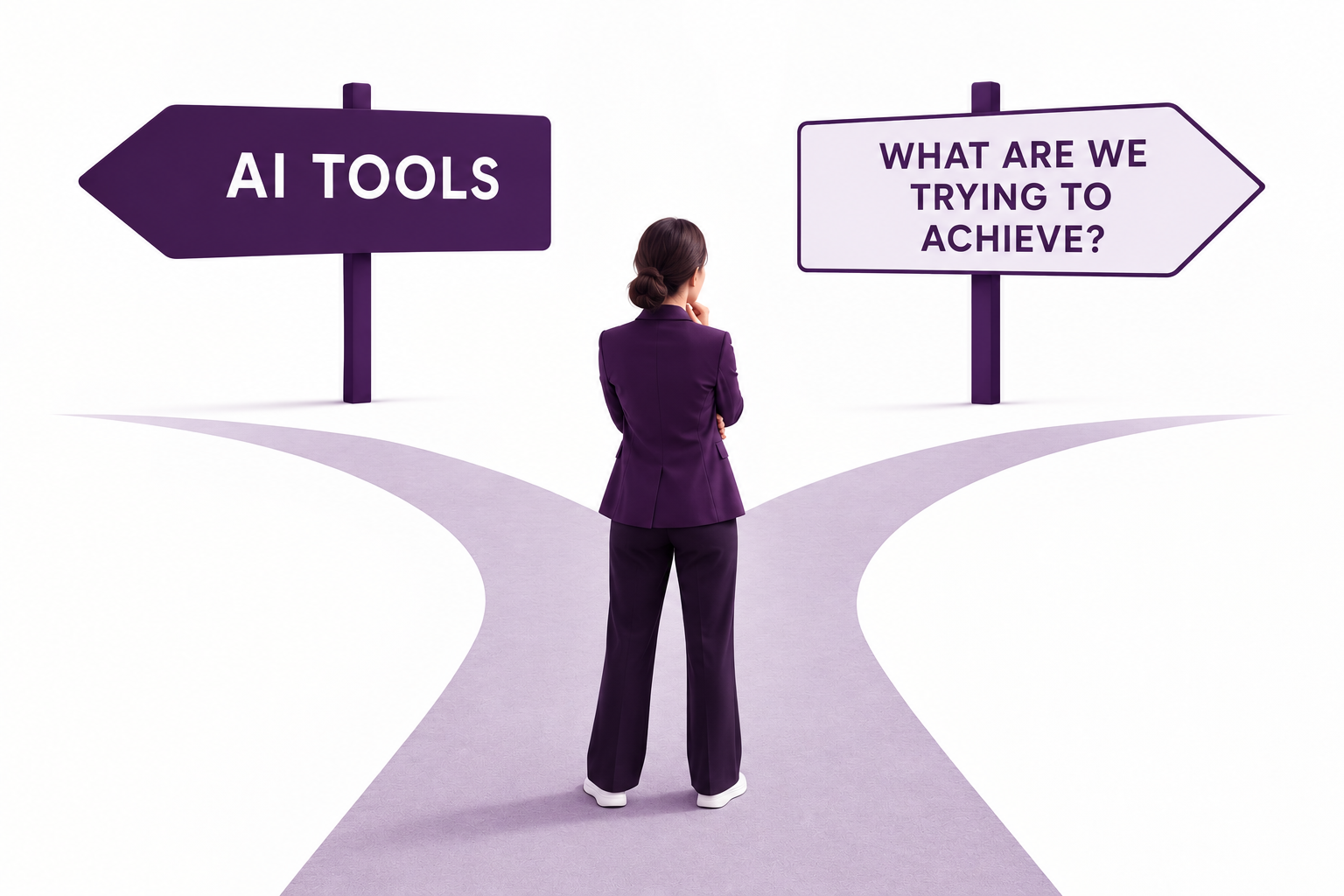
So they stitch it together themselves, land somewhere, and quietly wonder whether their membership delivered the answer, or just a map of where the answer might be.
That moment is the real test of an association's AI strategy. And most associations are about to fail it at a vendor renewal, for a reason that looks, from the inside, exactly like good judgment. The decision feels like buying a feature. What you're actually signing is who controls your AI strategy for the length of the contract.
First, the case for "included" AI, made as strongly as it deserves
The incumbents deserve a fair hearing, so start with theirs. If you're a COO, CIO, or VP of Digital, you likely have one (probably three) renewals on your desk this quarter, each offering AI bundled in. Your AMS includes it. Your LMS includes it. Your community platform includes it. And the pitch is genuinely strong:
Your users already work here. Your data already lives here. Your permissions are already configured here. AI can be switched on without a new procurement cycle, a new security review, or another line item your board has to defend. It's faster to deploy, cheaper to start, and lower-risk than introducing yet another vendor into a stack you just spent two years consolidating.
Every word of that is true. There are real situations where it's also the right answer: when the use case is workflow automation inside one system, when the content lives natively in that one platform, when you're optimizing for speed and simplicity. Reducing vendor sprawl is not a mistake. A practical buyer should want to hear this.
Which is exactly why it's dangerous. The bundled-AI argument wins by making the lowest-friction decision feel like the safest decision. Those are not the same thing, and the gap between them is where associations lose three years.
The category error hiding inside the renewal
Here's the distinction the renewal paperwork quietly skips over.
Bundled AI is a feature, and it works for the platform that ships it. Better search inside the AMS, better summaries inside the LMS, better recommendations inside the community. Every one of those improvements is real, and every one of them is engineered to make leaving that platform a little more painful. The bundled assistant's job is not to make your knowledge more useful; it's to make its host more sticky. Notice the direction of the arrow: it points inward, toward the system, not outward, toward your members. (And the arrow is about to get sharper. We're not far from the point where AI can stand up a passable community platform or member portal on its own over a weekend, which means the platform itself is commoditizing. What won't commoditize is an AI layer that can govern and reason across all of them at once. The integration is becoming the moat, not the software it integrates.)
AI knowledge management is infrastructure. It's the governed layer that sits above your AMS, LMS, CMS, community, and standards library and treats your curated body of knowledge as one association-owned asset. It doesn't replace your systems of record. It refuses to let any single one of them become the boundary of what your members can ask.
Put plainly:
Your AMS tells you who renewed. AI knowledge management tells you what members needed to know before they decided.
The higher the stakes on accuracy in your field, whether clinical guidance, technical standards, regulatory interpretation, or credentialing, the less you can afford to let one platform vendor's worldview define how that knowledge gets surfaced. A connector can read a source. It can't govern one. And connection is not governance.
AI lock-in is the trap platform lock-in only hinted at
Every association leader already understands platform lock-in. You've lived a migration, or watched a peer organization live one. It's expensive and it's slow, but here's the thing that has always made it survivable: the knowledge survives the move. When you switch your AMS, you lose workflows and configuration, but your standards, your guidance, your published body of work walk across to the new system intact, because you own them as content.
AI lock-in breaks that guarantee, and almost no one is pricing it in yet. When your AI is a feature of one platform, the part that gets trapped is not the content. It's everything the system learned: the corrections your SMEs made, the institutional voice it absorbed, the audit trail your reviewers built, the record of what members kept asking and kept failing to find. That learning layer is the most valuable thing your AI produces, and it is the one thing a bundled assistant will never let you carry out the door. Change platforms in three years and you don't just run a migration. You reset your AI strategy to zero and start the coaching over from scratch. Platform lock-in traps the system you were using. AI lock-in traps what your organization figured out while using it.
There is a quieter cost underneath the portability one. The day you wed your AI to a bundled feature, you also hand its roadmap to that vendor. What your AI can do next, what it will refuse to do, when it changes, what it costs to expand, all of it is now set by a company whose incentive is to keep you inside their walls, not to make your knowledge more independent. Your AI strategy becomes a passenger on someone else's product decisions. And the company now steering it is, almost always, not an AI company at its core. It's a membership, events, or community software vendor that added AI to defend a product, which means your most strategic capability is riding on someone else's secondary priority.
The way out is not a better feature. It's owning the layer itself, and having people beside you who have stood up governed AI for associations before and can tell you, specifically, what is and isn't possible with the knowledge you hold. Betty is built to be both: the AI knowledge layer the association owns and governs across every system, and the team that has done this with standards bodies, clinical societies, and trade associations and can help you take the reins rather than rent them.
The shift that turned this from "nice to have" into "this quarter"
For years the problem was framed as findability: members can't locate what you've already published, because it's scattered across the AMS, the CMS, the LMS, SharePoint, Dropbox, and a decade of committee email. That alone was costly. ASAE Foundation research found that content governance is simultaneously the most valued and most arduous content tactic, which is why fewer than half of associations use metrics to guide what they disseminate.
But since 2024 the frame has moved somewhere more urgent. Your members aren't waiting on your website anymore. They're already asking generic AI about your standards, your certifications, your profession, today. And as .orgSource put it for medical associations: if your content isn't structured for AI to read, "if your voice isn't in the conversation, someone, or something, else will fill the gap."
Sit with that. The question is no longer whether members can find your knowledge. It's whether the authoritative answer about your field comes from you, carrying your citations and your authority, or from a model that hallucinates confidently around content it half-ingested. Bundled AI, locked inside a single platform, cannot contest that ground. It was never built to.
What infrastructure actually does that a feature can't
Five things, specifically, and no number of connectors closes the gap:
- Answers across the whole knowledge estate. One question, one cited answer, drawn from standards, guidance, education, committee work, and SME expertise, regardless of which system each piece lives in.
- Multi-tier governance. Independent public, member, and internal instances, each with its own approved corpus and access controls. The same body of knowledge, expressed at three altitudes. This is also the structural answer to the tension between public AI discoverability and gated, non-dues-revenue content.
- Auditable provenance. Every answer traceable to its source. Legal, clinical, and standards reviewers can inspect the trail, not just trust a citation that may or may not be real.
- A correction loop that compounds. When an SME refines an answer, that correction becomes a durable knowledge artifact that improves every future answer. A thumbs-up that disappears into a vendor's model is not the same thing. Five minutes of expert time can shape thousands of answers, and quietly captures the interpretive knowledge that otherwise retires when your veteran staff do.
- Member-intent signal. What members ask, and what they ask and don't find, fed back to content, education, advocacy, and membership teams as a live stream. It's the thing surveys keep failing to give you, without the survey fatigue.
That is the line between a platform that has AI and an association that owns its AI knowledge layer.
And to be clear about what this is not: it isn't a replatforming project. Betty isn't an AMS replacement and won't fix a broken data stack. It activates the curated knowledge you already publish, working with your content as it is, and stands up in weeks, not quarters.
One proof point, briefly
The International Society of Automation pointed Betty at its standards library and saw more than 10,000 member conversations in year one, including 3,800 in the first thirty days, served in nine languages from English-language source content, every answer cited back to specific clauses members could verify. Its public-tier instance also sold memberships directly, to people who reached the association's knowledge before they were members. None of that came from "AI included with the AMS." It came from treating governed knowledge as an asset the association owned and operated.
The one question to ask before you sign
Don't ask your incumbent whether their AI is good. On a demo, everyone's AI is good. Ask the question that reveals the boundary instead:
If we leave your platform in three years, what do we keep?
If the answer is "the platform features you paid for," you're buying AI functionality: real, useful, and gone the day you switch vendors. If the answer is "your governed corpus, your corrections, your audit trail, your source hierarchy, and your interaction insights," you're buying AI knowledge management.
If the AI can't move when your systems change, it isn't infrastructure. It's a feature wearing infrastructure's job title.
Associations are knowledge companies. That's the whole asset: decades of curation, governance, and stewardship that no competitor and no model can reproduce. Your systems of record should stay exactly where they belong. The system of knowledge should belong to you.
See what your AI knowledge layer should look like
Betty is the governed AI knowledge management system associations use to make their full body of knowledge conversationally accessible, source-bound, multi-tier, and continuously improving, across whatever systems they already run.
If you have a renewal on your desk and an AI decision to make this quarter, book a 30-minute call before you sign. We'll walk your current stack, your knowledge estate, and what would actually change if your AI layer weren't owned by one of your vendors.