We've argued before that findability is an access problem, not a content problem — that the question isn't how much you've published, it's whether anyone can reach it. If you've followed along, you already buy that. So let's go one layer deeper, to the part that actually separates one AI assistant from another.
Because almost every AI tool on the market can now do the headline trick: a member asks a question in plain language, and an answer comes back. That's table stakes. It demos beautifully. And it quietly solves findability once — as if the gap between what members ask and what you have were a fixed thing you could close and walk away from.
It isn't. Your content changes. Your members' questions change faster. The distance between "what someone asks" and "what you have" gets redrawn every week. So the real question isn't can it answer. It's what happens after it answers — and that's where most solutions go quiet.
The one-shot tools are frozen the day you install them
Most bolt-on AI is built for a single hop: take the question, find the closest-matching text, rephrase it, done. A member who fails to find something fails the same way, forever, invisibly. The tool keeps no memory of the miss and no mechanism to be sharper tomorrow than it was today. It is exactly as smart on day 300 as it was in the sales demo — while everything around it has moved.
That's the trap. A frozen tool doesn't hold steady against a moving target; it falls behind it. The library it was pointed at drifts, the questions evolve, and the assistant grows less useful relative to your members' needs every week it runs. You bought it to close the gap. It's quietly reopening one.
Two things change that — and they're the things you can't bolt on later.
1. Permanent coaching: findability that gets better at *your* members' questions
A search box returns what it returns, in the voice it came with. It can't be taught.
An assistant that's genuinely built for your organization can. It can be coached to handle your most common questions the way your best staff member would, to reach for the right source, and to answer in a voice that sounds like you rather than a generic help desk. And because that coaching is durable, it accumulates. Every correction, every clarified answer, every "actually, point them here instead" makes the next thousand answers better.
This is the part that most AI products miss. You can wrap a chat interface around a content library in an afternoon. You cannot, after the fact, manufacture a year of accumulated coaching about how your members ask things and what a good answer looks like in your field. That history lives in your organization, and it can't be exported and reinstalled somewhere else. It's the difference between a system that's yours and a chatbot that merely sits on your domain.
2. The miss is the asset: insight into what your members actually need
Here's the reframe that matters most: the failed search is not a failure. It's your single most valuable event.
When a member asks something your knowledge can't answer, a one-shot tool produces an apology and an exit, and you're none the wiser. A system that closes the loop produces a finding — a precise, repeatable signal that there's a gap between what your members need and what you've published.
And the same loop that improves the answers is the loop that surfaces those findings. Which questions get answered cleanly, and which limp? Where did the assistant reach for an answer and come back empty? What did members have to ask twice? That's not log exhaust. It's a live, honest picture of what your members are trying to learn — in their own words, at the moment they need it. Most associations have never been able to see that directly. Surveys ask people to remember what they wanted; this shows you what they wanted while they wanted it.
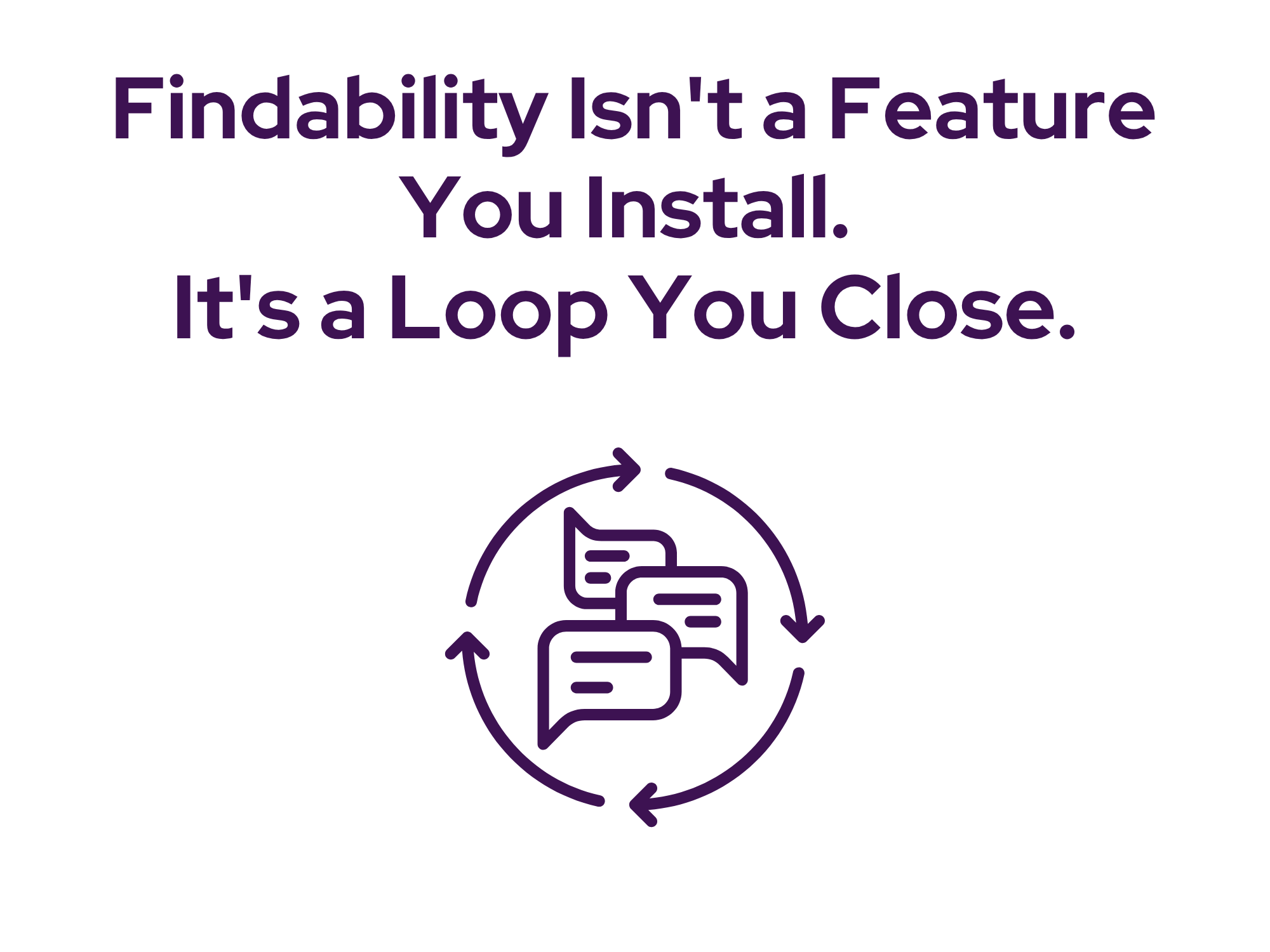
So the answer solves today's question, the pattern tells you which questions keep going unanswered, and you fix exactly the right gaps next. Findability stops being a one-time surfacing of what exists and becomes the ongoing work of discovering what's missing — and closing it on purpose.
Why the loop is the whole game
Put those together and the difference stops being technical and turns strategic.
A bolt-on tool depreciates from the day it's installed. A system compounds. Every question makes the next answer better; every miss tells you what to build next. The assistant gets more coached, more fluent in your world, more yours — and your view of what members need gets sharper at the same time. The longer it runs, the harder it would be to give up, precisely because what it has learned can't be replicated by a competitor starting from zero.
That's the test, and it has nothing to do with how impressive the demo was:
When a member doesn't find their answer today — what happens to that question?
If the answer is "nothing — they leave, and we never know," you don't have a knowledge system. You have a search box with a nicer voice. The gap is still there. It's just quieter now.