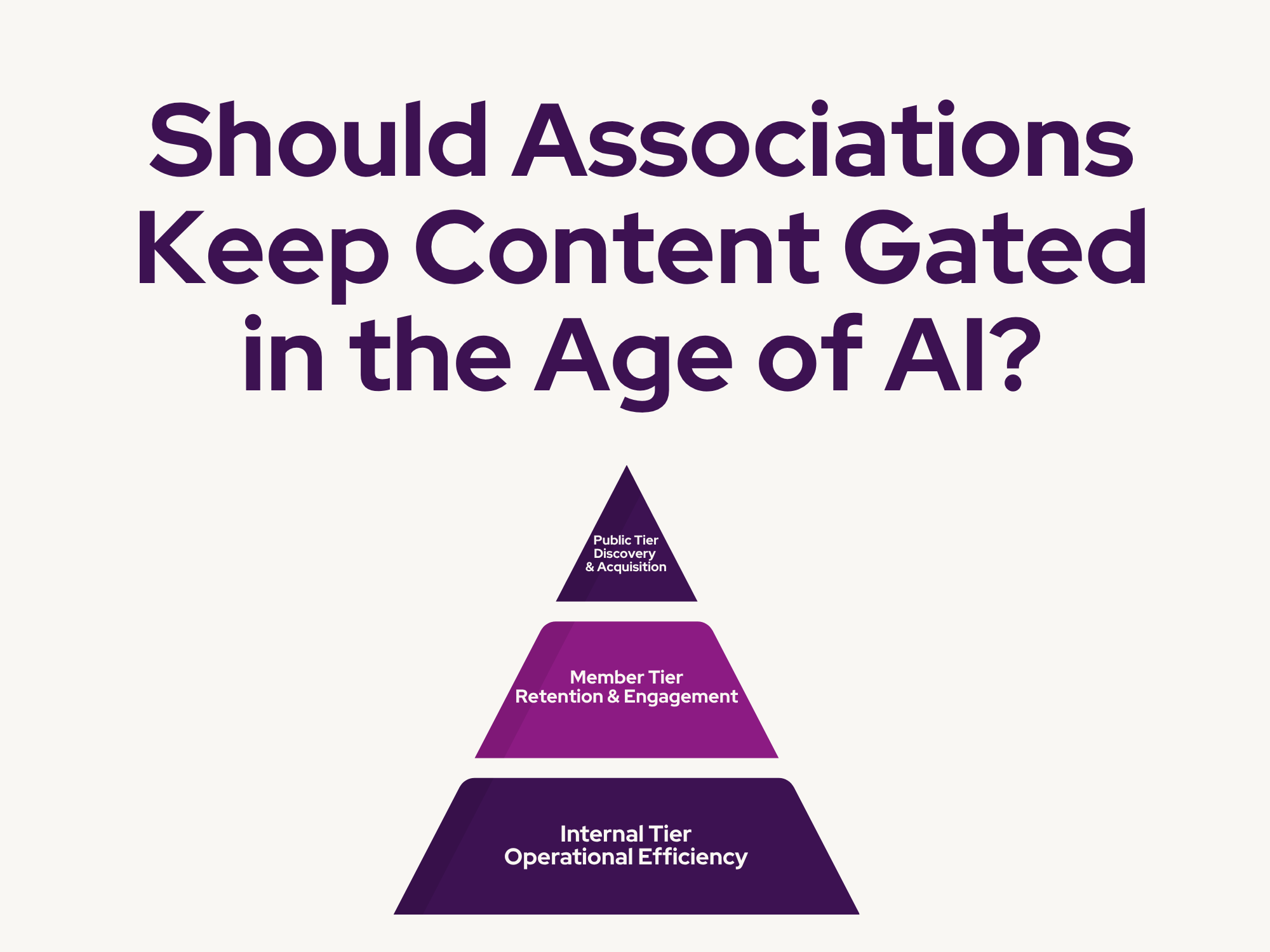
Professional associations should not treat content as either fully public or fully gated. The most effective strategy in 2026 is a multi-tier knowledge architecture: public content for AI discoverability and member acquisition, member-only content for retention and depth, and internal content for operational efficiency. Associations using this model are already generating measurable membership revenue from public AI-accessible knowledge experiences.
Key Takeaways
- The “all-public vs. all-gated” debate is the wrong strategic framework for associations.
- AI search tools like ChatGPT, Perplexity, and Google AI Overviews increasingly determine which organizations get discovered.
- Public-facing knowledge content can directly generate new memberships and attributable revenue.
- Member-only content still matters — especially for community, certification, personalization, and trusted peer knowledge.
- The strongest association strategy is a three-tier architecture: public, member, and internal.
- Associations that separate acquisition content from retention content make better long-term membership decisions.
Why Are Associations Debating Public vs. Gated Content?
The argument is happening in nearly every association boardroom right now.
One side sees discoverability collapsing. Search traffic is flattening. AI tools increasingly answer industry questions before a user ever clicks a website. Their concern is straightforward:
“If our association is not in the answer, we stop existing in the places professionals search for information.”
The other side sees decades of membership strategy at risk. Gated content has historically justified dues, certification pathways, and exclusive access. Their concern is equally rational:
“If we give away the knowledge, why would someone become a member?”
Both arguments are correct — which is exactly why the framing breaks down.
The real question is not whether content should be open or closed.
The real question is:
What Job Should Each Type of Content Perform?
Most associations still assume content has a single purpose: consumption.
Under that model:
- public content creates awareness
- gated content creates member value
But AI has changed how organizational knowledge moves.
Today, association content has at least three distinct business functions:
- discovery
- retention
- operations
Trying to make every page serve all three creates strategic conflict.
The solution is not choosing one side. It is separating the functions.
What Is a Multi-Tier Knowledge Architecture?
A multi-tier knowledge architecture separates content into distinct layers based on business purpose.
This is the model increasingly emerging among AI-forward associations because it aligns with how AI retrieval systems, member expectations, and staff workflows actually work in practice.
Public Tier: Discovery and Acquisition
The public tier exists to make the association discoverable.
This content is accessible to:
- ChatGPT
- Perplexity
- Google AI Overviews
- voice assistants
- traditional search engines
Its job is not to replace membership.
Its job is to ensure that when professionals ask questions about your industry, your association becomes the trusted source AI systems reference.
Public-tier content typically includes:
- foundational explainers
- industry definitions
- standards overviews
- introductory guidance
- regulatory context
- trend analysis
The strategic goal is authority and acquisition.
How Is Member-Only Content Different?
Member-tier content exists to deepen value and strengthen retention.
This is where exclusivity still matters.
Examples include:
- certification preparation
- advanced templates
- implementation toolkits
- peer-reviewed research
- community discussions
- benchmarking data
- member-specific personalization
- expert access
AI can summarize information.
It cannot replicate:
- professional belonging
- trusted peer communities
- credential pathways
- reputation signaling
- member identity
That distinction matters enormously.
Associations that gate everything often suppress discovery.
Associations that open everything often flatten differentiation.
The member tier preserves the high-value experiences that actually drive renewals.
What Should Stay Internal?
The third layer is operational knowledge.
This content should never be public, but it benefits enormously from AI-powered retrieval internally.
Examples include:
- onboarding documentation
- governance policies
- partner agreements
- HR procedures
- board records
- operational workflows
- internal SOPs
This layer exists to improve staff effectiveness.
For many associations, this becomes one of the fastest sources of measurable ROI because it reduces:
- duplicated work
- onboarding time
- institutional knowledge loss
- repetitive staff questions
Does Public AI-Accessible Content Actually Generate Memberships?
Yes — and this is where the conversation changes from philosophy to measurable economics.
Associations using public AI knowledge experiences are already seeing attributable membership revenue.
The International Society of Automation launched a public-facing Betty assistant called Mimo.
To date:
- Mimo has directly generated 13 memberships
- resulting in approximately $19,000 in attributable revenue
That revenue would not exist without a public discovery layer.
Similarly, the National Science Teaching Association has directly attributed four memberships to its public-tier AI knowledge experience.
This reframes the entire debate.
The question is no longer:
“Will public content cannibalize dues?”
The better question is:
“Does discoverable knowledge generate enough qualified new members to outweigh limited substitution at the margins?”
Current data suggests the answer is yes.
Why Is Public Knowledge Content Different From Traditional Marketing?
A public AI knowledge layer behaves differently than advertising.
A paid ad interrupts attention.
An AI knowledge interaction captures intent.
When someone asks:
- “What are the new automation safety standards?”
- “How do I prepare for science teaching certification?”
- “What regulations affect this industry?”
they are already seeking expertise.
If your association becomes the cited answer, the interaction begins with trust rather than promotion.
That makes public knowledge infrastructure an acquisition system, not simply a content strategy.
What Metrics Should Associations Use for Each Content Tier?
One reason these debates become emotional is because organizations try to evaluate every type of content using the same metric.
A multi-tier architecture fixes this by assigning each layer a distinct business purpose.
|
Content Tier |
Primary Goal |
Core Metrics |
|
Public Tier |
Discovery and acquisition |
Memberships attributed, revenue generated, AI citations, traffic |
|
Member Tier |
Retention and engagement |
Renewal rate, engagement, NPS, certification participation |
|
Internal Tier |
Staff efficiency |
Time saved, onboarding speed, operational cost reduction |
This gives:
- CFOs measurable ROI
- CEOs a coherent strategy narrative
- membership directors a clearer value model
- marketing teams a discoverability framework
Most importantly, it removes the false binary between openness and exclusivity.
What Mistakes Are Associations Making Today?
When associations map content this way, they usually discover two problems simultaneously.
First, they are gating content that should be performing acquisition work.
Second, they are exposing content that should be strengthening retention.
Both mistakes are reversible.
But neither becomes visible until the organization separates content by strategic function instead of treating all knowledge equally.
What Will Winning Associations Do Differently?
The associations that succeed in the AI discovery era will not choose between openness and exclusivity.
They will design intentionally for both.
They will:
- expose foundational expertise publicly
- preserve high-value member depth
- operationalize internal knowledge with AI
- measure each layer differently
- treat discoverability as infrastructure rather than marketing
The “exclusive content vs. AI visibility” conflict is real.
But it is being fought on the wrong battlefield.
The organizations that win are not picking a side.
They are redesigning the architecture.
Frequently Asked Questions
Should associations make all content public for AI search?
No. Associations should separate content by strategic purpose. Public content should support discoverability and acquisition, while member-only content should focus on retention, personalization, and community value.
What types of content should remain gated?
High-value member experiences such as certification prep, benchmarking, peer communities, templates, advanced implementation guidance, and proprietary research are strong candidates for member-only access.
Does public AI-accessible content reduce membership value?
Current association data suggests public discovery layers can generate new memberships and attributable revenue while member-only content continues to drive retention and engagement.
Why does AI discoverability matter for associations?
Professionals increasingly use ChatGPT, Perplexity, and AI-powered search experiences instead of traditional search engines. Associations that are absent from these systems risk losing authority and visibility over time.
What is an AI knowledge assistant?
An AI knowledge assistant is a retrieval and synthesis system that helps users access trusted organizational knowledge using natural language questions. Unlike a generic chatbot, it is grounded in curated association content and institutional expertise.
Ready to Evaluate Your Association’s Knowledge Architecture?
If your board is debating whether content should be public or gated, the more useful exercise may be identifying which content belongs in which tier.
A structured knowledge architecture helps associations:
- improve AI discoverability
- strengthen member retention
- increase operational efficiency
- measure content ROI more clearly
Book a demo to see what a multi-tier association knowledge strategy could look like in practice.